Frequently Asked Questions and Answers.
We receive letters and e-mails regularly and the frequently asked questions we
are asked are very interesting. The replies below provide useful information and
are well worth reading.
Q1 applies to fixed or motorised dishes.
It is THE most common question asked.
QUESTION F1
How much difference do low noise LNBs make and why do
some LNBs have a C120 flange and a feedhorn? Is there much difference
between the efficiency of different makes and types of dish?
AND,
How can I get more signal from my dish? Would a better LNB
help or a more sensitive receiver?
AND,
Problems with signal through trees.
AND,
Why does my lower noise LNB produce less signal?
ANSWER F1 -
Dish size is everything.
Dish size is everything. LNBs only have a very very very very .... small effect as does receiver
sensitivity. Dish size is everything! Going from a 0.9dB to a 0.1dB does not have the effect of
5mm of dish diameter! and then the lower noise LNB will only help in good weather, virtually no
effect in bad weather. Bigger dishes provide more signal in all weathers. BUT .. if the dish size
cannot be increased for any reason, the lower noise LNB can help a small amount and it MIGHT be
just enough to pull in a difficult to receive channel that was just coming in but maybe pixilation or
freezing (a common fault caused usually by lack of signal) was a problem and may be stopped.
0.1dB LNBs! To achieve 0.1dBs over a significant frequency range, manufacturers would need super
cooling to slow the electrons down! Simply not possible at normal temperatures in the UK. It may
well be the case that the new 0.1dB LNBs have the lowest noise figures. They are very good LNBs.
Possibly even be the best, but they really can't be as low as 0.1dB or 0.2dB over any kind of
useful frequency range if at all. Some of us are getting old! I can still remember - when I was a
kid - back in the late 1950s early 1960s - not sure when - being told you could get a great picture
on the TV with an aerial shaped like a PLANT POT that could be stood on top of the TV.
(even with a plastic plant inside it!) We all now know that what was really needed was a decent
sized aerial on the roof (and preferably not in the loft - which can produce reflections!
Many people would like technology without wires in sealed boxes (like my wife, she will insist
on having the stuff in cabinets with doors on. This is better known as an cooking the technology
in an oven as it stops ventilation and creates a fire risks).
Many also want the smallest possible dish so the question is - "find an alternative solution to
getting more signal" BUT ... no matter how much people might want to .....
YOU CAN'T CHANGE THE LAWS OF PHYSICS! "Dish size is everything." It is a question that we hear
every day and sometimes customer think that if they ask the question in 4 or 5 different ways, they
will eventually hear a different answer. To repeat - Dish size is everything! Dish size is everything!
Dish efficiency.
This can be important. Especially among large dishes. The Andrews (Channel Master) 1.8m and 2.4m have a
very high gain due to very good design. Offset should be more efficient than prime focus if it is a
specialist well designed dish (not always true with smaller mass produced dishes). Webbed resin type plastic
is a perfect shape from leaving the factory to arriving at the customer. Metal petalised prime focus dishes
can be warped when they are new due to bad assembly or damage and tend to be very in-efficient.
See the Andrews (Channel Master) dishes on the
fixed dishes page and
motorised dishes page
for very high quality resin type perfect shaped dish products.
Matched feedhorns can pull in more signal than better LNBs. See below.
Feedhorns.
A normal 40 mm clamp LNB has an integral offset feedhorn for offset dishes like the
Triax dishes (see offset dishes on the
dishes page )
A Prime focus dish like the Unicorn (see an example of focus dishes on the
C Band LNBs page
A Prime focus dish should have its own feedhorn with "scalar rings" on one side and a
C120 flange on the other. See the prime focus feedhorns shown on the
Feedhorns
page
i.e. the Universal Feed and the Invacom feed, here you should use the C120 flange LNB which fits the Prime
Focus feed. If a prime focus dish does not have a proper feedhorn then it should have one.
The scalar rings on a prime focus feedhorn are a very important part of the design.
The feedhorn should really be designed and made by the dish manufacturer for a perfect match
but if this is not known or possible, fit a the
"universal feedhorn" on the feedhorns
page This will be the
best match possible. This kit only requires you to have the 3 feed support arms. The boss etc
is all in the kit.
The Andrews (Channel Master) offset feedhorn.
We have supplied this feed to customers who have found it made a worthwhile improvement.
If an LNB feed is not a perfect match, like a standard 40mm clamp LNB, it may illuminate (say) 1.1m
of a 1.2m dish. (less signal) OR, It may (try to) illuminate 1.3m of dish. This will cause infrared
(noise) to be picked up round the edges. The result is a poor signal to noise ratio. (poor picture)
Feedback from customers suggest that the matched feed on a Channel Master 1.2 as far west as Belfast
brought in all of Sirius. Before it was fitted this was not possible. More feedback suggested it can
make a difference in southern Spain For Sky TV and the BBC on an Andrews 1.8m dish and on the 2.4m Andrews
(Channel Master) dish from the Spanish offshore islands.
Receiver sensitivity.
This has only a very small effect on the signal. Most CI and free to air receivers are sensitive anyway.
Some Sky digiboxes, however, do not have particularly sensitive tuners. Not a problem in the UK but
in Spain a sensitive satellite receiver can help a little.
More information about LNBs.
An LNB is the box of electronics on the end of the dish boom arm. It acts like a aerial masthead
amplifier. The signal (microwaves) reflect off the dish and into the feedhorn to the LNB.
Here it is amplified and the frequency is lowered. The lower the noise figure the better.
i.e. in simple terms, it pulls in the signal better. The signal is then sent down the coaxial cable to the
satellite receiver. Quality digital cable should be used. (not CT100 or RG6)
See our
Satellite Cable for good digital cable. Also see
Twin satellite Cable and
4 LNB (quad or quatro) satellite Cable
A universal LNB covers the KU band from 10700 to 12750Ghz with LO frequencies of 9750 and 10600.
There are
Single LNBs, Twin
LNBs, Quad LNBs, Octo
LNBs and
Quatro LNBs. Single have one output,
twin - two outputs, quad - 4 outputs and Octo - 8 outputs. All outputs are the same and are equivalent to
a single LNB. A twin LNB could be used for two single tuner satellite receivers or a twin tuner satellite receiver
Quatro LNBs have 4 outputs and they are all different. Quatro LNBs can only be used with
multiswitches.
There are also 40mm clamp LNBs and C120 LNBs. This refers to the way they fit on a dish. A 40mm LNB has an
integral offset feedhorn and fits to the most common types of offset dishes.
C120 flange LNBs fit on a separate feedhorn and could be used on either offset or prime focus dishes.
They are usually used on specialist high quality dishes.
Both 40mm and C120 LNBs could have single, twin, quad or quatro outputs.
At the moment only 40mm LNBs have octo outputs.
Using a quatro LNB and a multiswitch it is possible to have many more outputs. Even 32 outputs or larger.
A
Sky mini dish LNB uses a fixing that is none standard and a tongue fits into the end of the boom
arm
To conclude,
"Dish area is everything". Other small gains are possible but they are small.
Large increases in signal are possible in all weathers with bigger dishes.
A large gain can be made if a dish is found to be warped and then corrected.
More efficient dishes provide gains but not as much as manufacturers claim they do.
When a manufacturer says their 50cm dish is equivalent to other 60 or 80cm dishes,
This is marketing not science! (Putting it another way this is sales jargon for lying!)
A more efficient dish might have the effect of being as good as a dish 1.0cm diameter bigger
but not the sort of silly claims some manufacturers (or dealers) make.
Small gains are possible with matched feedhorns
Very small gains might be possible with better LNBs or more sensitive tuners but they may be
too small to be significant
If trees are in the way, the signal will not get through them, however, if they are on the fringe
of being in the way - maybe only a thin band of branches and leaves with a good proportion of the
signal actually getting through, a bigger dish will collect more signal and compensate for the problem.
Better LNBs can producing less signal.
This is a very common question.
The important point here is that only a higher signal to noise ratio matters not the total signal level.
The total signal level is shown on a satellite meter and is NOT relevant. Meters do NOT measure the
quality of an LNB as meters are NOT measuring signal to noise ratio (over a frequency band.)
A high (signal) output LNB is good for driving a signal down a long cable (e.g. over 40m)
But a high signal to noise ratio pulls in weaker signals.
Remember - if you are looking at the meter reading in your receiver THAT TELLS YOU NOTHING AT ALL
as far as this particular question is concerned.
It only shows you the total signal and not the difference between the signal and the noise.
A poor 0.9dB (but high output) LNB on a short cable (not much attenuation) can produce
a large reading on a signal strength meter than a low output 0.1dB LNB.
A low output LNB (like an excellent 0.3dB Invacom) on a longer cable can show a low
signal on a signal strength meter.
So what?!! it has nothing at all to do with the ability to pull in a weak channel - nothing at all.
At a technical level, if you draw a graph with a horizontal line representing the signal
and a lower horizontal line representing the noise, the meter is simply showing the level of the
top line. With a high output LNB on a short cable the two lines move up equally BUT the height
difference between the two lines does not alter. With a low output LNB on a longer cable the two lines
move down equally BUT the height difference between them again does not alter. With a lower noise
LNB or bigger dish the height difference between the two lines INCREASES - we say there
is a better SIGNAL TO NOISE RATIO. A signal strength meter does not measure this parameter.
Anyone who says it does, probably has a no technical background in electronics. It is like
saying that the signal to noise ratio of a Hi Fi system is better if you turn up the volume.
Your ears would be equivalent to the signal strength meter and this statement would be
total rubbish as well - but it is an interesting, accurate analogy.
The only test is to check out the capability of pulling in weak channels - do not use the meter
for comparing LNBs. The meter is designed to help to locate the satellite accurately and
not to test the LNB.
What difference does it make to the signal if the dish is prime focus or offset?
See
answer 8 below
FIXED DISH QUESTIONS
QUESTION F2.
Can I receive 3 or 4 satellites on one fixed dish using a bracket?
e.g. Sky, Astra 1 and the Hotbird.
or 2 satellites from one fixed dish, 28E and 13E or 28E and 19E etc?
ANSWER F2.
Questions about getting, 28E, 19E and 13E (i.e. Astra 2 (BBC and Sky) Astra 1 and the Hotbird.) etc.
Up till now, the products to do this have been poor and generally have not worked.
However, Triax have produces a very well engineered 3/4 LNB system bracket that is matched
to their TD range of dishes. The new bracket is made of aluminium and is extremely well made.
It fits perfectly on the TD range of dishes like the TD 78, 88 or 1.1m
We have tested it on the Triax TD 78cm dish. In Newcastle, perfect results were
obtained from 28E , 19E and 13E The 4 LNB bracket with LNBs and Diseqc switch can
be seen on the
accessories page
The TD dishes with the 4 LNB bracket with LNBs and Diseqc switch can be seen on the
2/3
satellite dishes page
The whole dish kit with recommended receivers can be seen on the
3 or 4 satellite system
page
Or check out the
2, 3 and 4 sat menu page.
Here are some more details,
3 Satellites are also possible on our
85cm 3 sat clear transparent dish.
Triax perfect fit rigid multi bracket, 4 way Diseqc switch, Wall mount and instructions.
Unlike flexible difficult to set up, universal fit brackets, this is a dream to use as it is
well engineered and designed by Triax for their own TD dishes. We have tested this ourselves.
Using a Lacuna meter, a ground stand and Triax TD 78 with the Multi LNB kit.
They were set up it our testing area. It took 10 minutes to get prefect results from all
3 satellites including setting up the stand and dish! (Testing was done with the Fortec
star 5100 receiver) Location - Newcastle - UK 20 degree look angle means that on one dish,
Astra 2 (28E), Astra 1 (19E) and Hotbird (13E) can be received.
Narrow feedhorn LNBs are used so that satellites that are only 3 degrees apart can be received
if required. To summarize, it is possible to receive from Astra 2 to the Hotbird on one fixed dish.
(Could also be used for other combinations of satellites)
Also note that on the
mutibracket page there is a twin option so that a twin LNB can be put
in
the 28E position on the bracket so that a Sky Digital can be used as well as a CI receiver.
Here is an e-mail with photos from a
customer, 20th April 07.
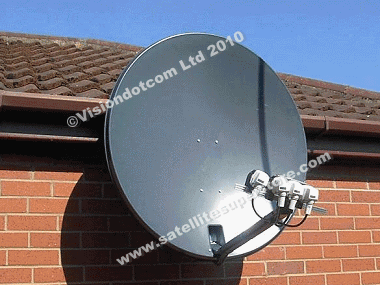
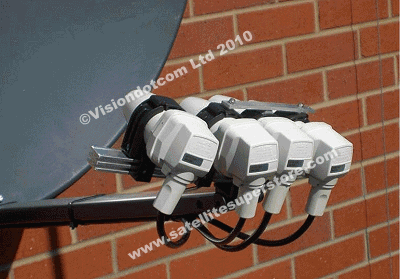
I have some interesting photos which you might like. When I was making the arrangement
to get them 3 degrees apart, it was a most interesting exercise! It was, however, well
worth the effort. I have 13, 16, 19.2 and 23.5E all coming in strongly.
James in Brigg, North Lincolnshire.
Our comments - James has done a good job here. He has even made a
small modification. Notice the aluminum bar along the top of the LNBs to
improve rigidity.
QUESTION F3.
Will the Triax Multibracket for 28E, 19E and 13E work in France?
ANSWER F3.
See the
3 or 4 satellite system page (There is no issue
in the UK where the bracket works fine on an 80cm dish. - although in the
north a 90 is recommended) To receive Sky / 28E in France you need a 60cm in the North,
80cm by the time you get to Paris and a 90cm in the south and south west.
(We quote dish sizes to receive the lowest power channels like the BBC although smaller dishes
will work on a % of the channels but not the lowest power.) Astra and Hotbird are powerful
in France and probably only need a 60 for either. Using a 90cm dish and multibracket in the south
is then a problem as you are sharing the signal between 3 satellites and there is therefore a
drop in signal of maybe 3 to 6 dBs on LNBs not in the centre of the boom arm. (centred on 19E,
the 28E LNB is off-centre). It therefore follows that a bigger dish is needed to make up for
losses in a lower signal areas like France etc. A solution, in theory, might be the Triax 1.1m
dish which is also compatible with the multibracket but we have had no sales of that type
and hence no feedback from customers to confirm it works well in that area.
QUESTION F4.
When would you advise the use of a "monoblock type"
product for a two satellite fixed dish system?
ANSWER F4
Yes, our latest monoblocks fit in the 40mm LNB clamp and work very well.
These monoblocks are ideal for-
6 Degree monoblock - 19E and 13E
3 degree monoblock - 19E and 16E or 16E and 13E
4.3 degree monoblock - 9E and 13E
other combinations are possible. Some twin and quad monoblocks are also available.
See them on our
Monoblock page
QUESTION F5
I do not know anything about tuning satellite systems and am
tired of waiting for engineers to come out and do it for me. That is why I wish
to buy a digital sat finder, but at the same time I do not want to pay an arm and
a leg for one. Is the Digisat Pro any good or can you recommend something else.
I need to take into account that I may need to use it overseas in Europe.
Can you supply more information on the satellite meters you sell?
ANSWER F5
The are a number of satellite finder meters available. See,
the satellite meters
menu page
The
Satellite Finder kit. is a useful low cost meter kit.
Fine for setting up all satellites
It includes a compass, battery box, fly lead and instructions.
Ideal for setting up a motorised or fixed dish system
Also very sensitive for detecting weak signals.
The
Primesat SF500. and
Primesat SF3000. low cost meters which identifie the satellite. Ideal for
the caravaner
The
Primesat FS700. another low cost pro meter which identifies the satellite with many professional features.
Again ideal for the caravaner
The
Primesat pr8000. This very high quality meter identifies the
satellites, has a built in
TV, built in spectrum analyzer information, video output and easy flexible updating.
RV, Motorhomes and caravaners please note,
There are two types of customer,
1. A customer buying a satellite system for their home intending to fit it themselves.
This type of customer don’t mind spending an hour or so fiddling around with a sub £40
budget satellite meter as they know it is a one-off install and it is worth saving the
money and putting up with the inconvenience of a budget meter.
2. Professional installers and caravan users. These people want to set up real fast and
once assembled, a professional meter (cheapest at £79.95) takes only a few minutes to find the
satellite. Caravan users can set up and get on with there holiday without the frustration
of all the trial and error searching needed with budget meters.
Note. Some caravan users prefer not to take this advice and take only the budget meter.
A far proportion come back to us after their holiday with comments like
“yes you were right. – not going through that again – send me a decent meter”.
Also read the next question.
QUESTION F5b
Professional satellite meters - what type of meter will work with a quatro lnb
and which lnb output would I need to connect it to?
ANSWER F5b
Using any
professional meter with a quatro LNB poses a few problems. In the end it is not an issue as long as you
understand the technical reasons and choose an approach which works best for you. First it is important to understand how a quatro
LNB works compared to a normal LNB like a quad. A quad LNB is simply 4 single LNBs in one package. Putting it another way, all
outputs carry all 4 components of the total signal. The total signal consists of 4 components due to there being 2 frequency bands
and 2 polarities. They are - high band vertical, high band horizontal, low band vertical and low band horizontal. Every component
carries 25% of the frequencies or channels. Every output of a quad (or a single or a twin) LNB carries every component or every
frequency and every channel. A quatro LNB does not. Here every output carries a different component - HV, HH, LV, LH This is what
is needed to make multiswitches work. (Some multiswitches will work with a quad LNB but their input circuitry converts the quad
signal to a quatro type signal). The next thing to understand is how a professional meter works and how it identifies a satellite.
The manufacturers look for a unique frequency on every satellite so that any satellite can be identified. Therefore, when looking
for a particular satellite like Astra 2, the meter might be looking for a frequency which happens to be (often it is 10,714GHz H
which is low band horizontal) "LH" (meters often have more than one (tag ID or tag frequency) frequency programmed into them
for each satellite, sometimes they have all 4 components available for selection in the menus but since finding unique frequencies
is difficult without a "cross identification conflict" (cross ID) there may be only one choice. At any rate without going into
the menu of the meter, the meter defaults to a particular frequency / component. Therefore, if a dish is being set up on a
particular satellite and the default frequency component to find that satellite is LH, if you connect to the LH output of the
quatro LNB, no problem. If you connect to any of the other outputs VH, HV, HL, it will not find anything. If you have not checked
the menus in the meter to see what the "tag" frequency and polarity is for the particular satellite you are looking for, then you
don't know which output on the quatro LNB to connect to (all outputs on a quatro LNB are marked LH, LV, HV, HL) In that situation
you have a 1 in 4 chance of connecting to the correct output and so by trial and error 1 output will find the satellite and 3
will not. This is a bit tedious although if it is mainly Astra 2 you are looking for, you would remember to connect to LH if you
had previously checked the tag frequency component in the meter was LH. A simple solution is to always carry a single LNB.
When we think back 20 years to when we used to install satellite TV, we would not go anywhere in the vans without spare LNBs.
There is no point it trying to fix a customers satellite system without parts which can be substituted in to assist the fault
finding process. Also a single LNB is cheap and so you are not tying up much money. Another alternative is to connect the quatro
LNB to the multiswitch with 4 short cables and keeping the multiswitch near the dish, connect the meter to any output of the
multiswitch. Every output carries all 4 components and is equivalent to a single LNB. Taking a multiswitch up a ladder and finding
somewhere to put it while you do all this might not be easy. To conclude, carrying a single LNB, finding the satellite, then
later fitting a quatro LNB is probably the easiest method.
This also partly explains why it is better to sell
multiswitches which work with quad LNBs as well as quatro LNBs. By fitting a
quad LNB, it makes it easier to find the satellite with a professional meter as it does not matter which output you connect to.
They will all work. In addition, it should be noted, most dishes in the UK are "Sky mini dishes" and not "standard dishes".
Sky mini dishes can only be fitted with a Sky quad LNB (or Sky Q LNB) but not a quatro LNB. This type of dish is particular
to the UK and Sky TV. Standard dishes can be fitted with either type of LNB. Therefore using mutiswitches which work with
quatro
and quad LNBs, means the LNB on a Sky mini dish will work with the multiswitch and the dish does not need to be
changed for a standard dish (with 40mm clamp) and quatro LNB (which fits a 40mm clamp). In addition, and as stated
above, it makes it easier to set up any dish on a satellite with a professional meter is a quad LNB is fitted.
Further info. - low band is 10,700GHz to 11,700GHz and high band is 11,700GHz to 12,750GHz The bands are switched
with a 22KHz tone and so tone off gives you low band and tone on gives you high band. A satellite meter (or a satellite
receiver) will insert the tone automatically depending on the (tag) frequency selected.
QUESTION F6
I do not know anything about tuning satellite systems and am
tired of waiting for engineers to come out and do it for me.
That is why I wish to buy a digital sat finder, but at the same
time I do not want to pay an arm and a leg for one. Is the Digisat
Pro any good or can you recommend something else. I need to take
into account that I may need to use it overseas in Europe.
ANSWER F6
For the price it is excellent. It works on all satellites including
fully digital (most low price meters will not and it gives signal strength
on a digital read out and a tone provides signal strength info as well.)
It also has other useful features but it cannot identify the satellite.
You have to check the TV to see if you are on the satellite you are looking for.
i.e. have a pre-tuned channel ready and see if it is there. If not try another satellite.
With experience it is possible to know which satellite is which just from signal
strengths as you learn that 19E and 13E are the two very powerful ones and so 28E
for example is just to the left of them ..... etc.
The Lexium and Satcatcher meters identifies the satellite. They identify and display information like -
28E found or 13E found. They identifies many satellites and provides signal strength and quality.
However, they are more expensive. Also read the previous question above.
QUESTION F7
Distribution questions and answers.
I want to have multiple satellite points around the house
and multiple receivers. I also want to distrubute the TV from one receiver to all TVs how
can this be done. and -
How can I use Sky Q with standard multiswitches?
How can I run 2 x freesat 4K receivers using one dish and a wideband twin LNB?
How can I use 2 x freesat 4 K receivers and a Sky Q receiver from one dish and one LNB?
How can Sky Q be sent to multiple appartments from one dish.
ANSWER F7 (and see 7b below as well)
There are several parts to this question.
Input
To provide many satellite dish points, (e.g. Sky or freesat) around the house you either need a quatro LNB on your
dish or a quatro LNB dish kit. see
dishes with quatro LNBs
and a 5 input multiswitch
(multiswitches are usually situated in a loft or cupboard or central area.)
See
multiswitches.
(Please note our latest
EMP multiswitches also work with quad LNBs or 4 outputs from an octo LNB.
Most other makes only work with quatro LNBs)
The quatro or quad LNB (with 4 outputs) feeds the multiswitch
using 4 LNB cable - see
4 LNB cable
Best to put two outlets in each room as it may be that twin tuner receivers
(record one channel and watch another) may be needed. (These are called twin tuner PVRs) If so use
the twin wall plates see
outlet plates
then scroll down to the twin units. Use twin cable to each room. see
Twin cable
For (e.g.) 6 rooms a 12 output multiswitch would be used. Twin cable to each room. An aerial can be fed
into the 5th input of the multiswitch if required. Using a wall plate which has a diplexer built in, two
satellite points and an aerial point is available. The UHF aerial signal is added to the satellite signal
by the multiswitch and goes down the same wire as the satellite signal. If two or three aerials are required
e.g. TV, FM and DAB radio, a 3 way combiner can be fitted on the roof and the one cable from that unit goes
into the 5th input of the multiswitch. Again the appropriate wall plate is needed to separate them all out
again. See
multiswitch combiner
Standard Sky, Sky+ Sky HD freesat and freesat HDR and other receivers can then be connected
to the F connector wall plate. Everything you may need is on the
Multiswitches Menu Page.
Sky Q update October 2016.
Sky Q multiswitches are now available but it is now also possible to combine
Sky Q multiswitches with standard
multiswitches. There are three options. Use only a Sky Q multiswitch, or use a Sky Q multiswitch with a standard
multiswitch, or use a Sky Q interface with a
standard multiswitch. A Sky Q multiswitch (e.g. 5 in and 4 out) is
cascade-able. That means it has LNB loop-through. So it is really 5 in, 4 Sky Q outputs and 4 quatro LNB outputs
(the 5th output is terrestrial) which can link to a standard multiswitch. That means it can be introduced in
front of a standard multiswitch (between LNB and standard multiswitch.) Sky multiswitches will only work with
quatro LNBs and not with the quad LNBs which are on Sky mini dishes. The other option is the
Sky Q interface.
This is connected to the output of a standard multiswitch. 4 short cables (the interface would sit beside the
multiswitch) coming from 4 of the outputs from a standard multiswitch connect to 4 inputs in the Sky Q interface.
The Triax interface converts these 4 inputs into the 2 Sky Q outputs and 2 normal outputs. Two rooms can then be
supplied with a Sky Q feed (remember a Sky Q feed from a Sky Q multiswitch or interface only needs one cable not two).
The rest of the rooms would be fed with standard outputs and so Sky HD, freesat and standard receivers
can be used in those rooms.
Summary of these questions-
Can you run 1 or 2 of the new recordable freesat 4K receivers and 1 or 2 of Sky Q receivers all from 1 dish AND have
access to all of the new features of these advanced receivers.
This answer also applies to running 2 x Freesat 4K receivers from 1 LNB or running 2 x Sky Q receivers from 1 LNB
Answers -
Research and putting together technical pieces of a puzzle to solve the problem. This is an interesting question
and we have a solution. The solution is a result of research here for months and will take quite a lot of explaining.
It requires some background information and so I am going to break down the explanation into blocks of information.
Suffice to say I don’t believe any other company has worked out a solution to this problem but this is right up
our street. Technical stuff like this is what we do every day and it is how we support our customers for 30 years.
1. You need a hybrid LNB on your dish. If you already have a hybrid LNB on you dish, no problem. If not, first
you must identify what kind of dish you have. There are 3 options.
a) If you have a Sky Mini dish that is less than 10 years old you can fit a Sky Mini dish hybrid LNB (most
people will have this option - a less than 10 year old Sky mini dish).
A Sky mini dish looks like –
Sky Mini Dish and the (2+4) correct hybrid LNB is at –
Hybrid LNB for a Sky Mini Dish
b) If you have a standard dish you need a 40mm hybrid LNB.
A standard dish looks like this –
Example of a Standard Dish
The 40mm hybrid LNB is at –
hybrid LNB for a Standard Dish
c) If you have a Sky mini dish that is over 10 years old, the new Sky mini dish hybrid will not fit as 10
years ago Sky changed the design of their dishes. If this is the case you must change the dish. We would
recommend the dish is changed to a standard dish as they are higher quality. Note, with earlier Sky mini dishes,
the LNB had a tongue and slid into the end of the box section boom arm. Later Sky mini dishes the LNB fits
on top of the boom arm.
2. It is important to know what a hybrid LNB is. A hybrid LNB has 2 + 4 outputs, 2 outputs are the new
twin wideband LNB and 4 outputs are universal LNB outputs also called “Legacy” outputs. In other words,
these 4 outputs are a normal quad LNB.
3. The latest freesat 4K recordable receivers have new advanced features which only work from a wideband LNB.
If the new receiver was connected to a normal twin LNB and twin cable you would be able to record 1 channel while
watching another. If the new freesat 4K receiver is connected to a new wideband LNB, which is a new type of twin LNB,
again using a twin cable, you can record several channels while watching another. Sky Q has similar features and will
also work from a wideband LNB and have the same recording capabilities, however, since the wideband outputs are
being used by 1 or 2 freesat receivers we must use the quad outputs of the hybrid LNB for the Sky Q receiver. If
the 4 quad LNB outputs of the hybrid LNB are connected to a “Sky Q Interface”, you can then use 1 or 2 Sky Q master
boxes. A Sky Q interface has 4 inputs which connect to the quad LNB outputs of the hybrid LNB and 4 outputs to go to
1 or 2 Sky Q receivers See the Triax Sky Q interface at –
Sky Q Interface
The reason a Sky Q interface is required is because Sky Q has an additional capability which a freesat 4K box
does not have. That is something called “dSCR”. It means if it is connected to a quad LNB through a Sky Q
interface, multiple channels can then be recorded while watching another.
4. In number 3 above, it explains how 1 or 2 Sky Q master receivers can be run from the 4 outputs of a
hybrid LNB using a Sky Q interface, however, we now need to consider how to run 2 x freesat 4K receivers
from the one set of twin wideband outputs from the hybrid LNB. This needs a wideband splitter - See
Wideband Splitter
Unlike a normal twin LNB which contains 4 components of the satellite signal and cannot
be “split” to 2 receivers, each output of a wideband twin LNB carries only one component of the satellite
signal and so it can be split. You could use 2 x IF splitters, (one for each output) but a much better
solution / product is a professional Triax 2 in and 4 out wideband splitter. It is 2 splitters in 1 package.
This is a product which Triax uses for a different application but we realised it could be used to solve
this problem. Connect the wideband LNB into this splitter and it gives you 2 x wideband outputs to go to
your two freesat 4K receivers.
Summary. To run 1 or 2 freesat 4K receivers and 1 or 2 Sky Q receivers from 1 dish requires a hybrid LNB (£39.95),
a Triax professional wideband splitter (£49.95) a Sky Q interface (£124.95) and our telephone or email support
on how to connect it and set it all up. If you have a Sky mini dish which is over 10 years old, you will
need a standard dish and wall mount (£49.95) otherwise the hybrid LNB will not fit.
Output.
Distribution round the house needs a 2, 4, 6 amp or (preferably) professional 8 way amp and cabling.
See
Professional 8 way amp and extra
TV eyes.
This is to distribute TV from one receiver to other TVs around the house (one channel)
This can be done by feeding a cable from the room containing the sat receiver to the multiswitch location and
into the 3 way combiner then into the multiswitch. However, the problem with this method is that the multiswitch
will not permit the 9 volts to go through and the TV Eye or omni link system to work for control. It is better
therefore to have a completely separate output system with separate cabling for the distribution system
This would mean 3 cables to each room, two for the satellite and one for the distribution. TV eyes for Sky receivers
Sky accessories
or omni link systems for freesat receivers or other receivers
see the
omni link kit
(and a modulator is required - same page or use an analogue
Triax Trilink)
This will allow full control of the Sky or freesat system from all of the rooms (but only in UHF analogue).
Latest information on HD 1080p output distribution.
Triax HD Modulator with TV eye control
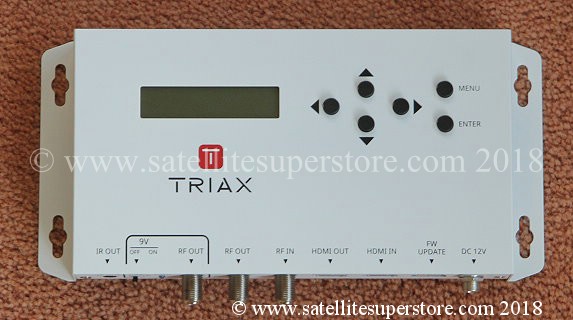
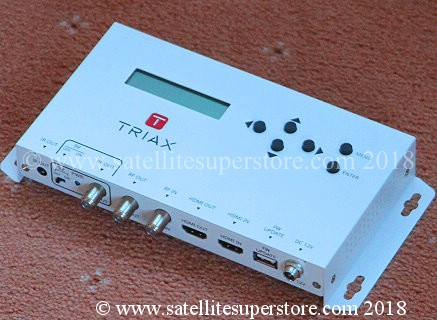
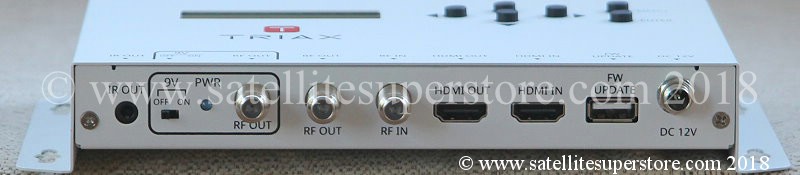 Important -
 Unlike many other modulators on the market, this one can be controlled using the TV eye system. It has
control built into it. (Some people already have a TV eye system in their home). Just put a tv eye on the end of the
cable going into the back of your (e.g. bedroom) TV and you can control the satellite receiver in the main room from
the bedroom. Also unlike other modulators, this one has and HDMI loop-through which means when the HDMI lead
goes into the modulator, it also loops out to go to the TV next to it. Most modulators do not have this function
and if not, an additional HDMI splitter is needed. No splitter is needed with this modulator.
The HD modulator, has an HDMI input and a coaxial cable output. Many houses already have a UHF distribution system.
A similar system in the past would take the coaxial output from the UHF (RF) connection of a receiver, maybe to an existing
distribution amplifier in the loft, then cables down to the rooms. This new HD modulator will work with your existing
distribution system. Satellite receivers now have an HDMI output. Connect the HDMI output from your satellite receiver
into the HD modulator. The coaxial output of the modulator can go direct to a second TV elsewhere in the house, or it
can go to a distribution amplifier (which may be in the loft) and then to many rooms. This coaxial cable then plugs into the
digital tuner input of your TV. All you then have to do is tune in the channels on your TV and one of the channels will be the
satellite receiver from the main room. This can be in full 1080p HD. Additional notes. The old UHF system in use for, probably
30+ years from an RF output was analogue and not very good quality. Usually there was an RF modulator built into the satellite
receiver and you had to tune in the analogue tuner of your TV set. Today many flat screen sets have both analogue and digital
tuners. Since there is no analogue TV any more the analogue tuner only tends to be used for tuning the old UHF, RF distribution
system but the new HD modulator works through the digital tuner of the TV in full HD. There have been some HD distribution
system which use CAT 5 cable but this system of HD over coax means that the old existing distribution system using coax can
be used and will it all work in full HD. There is an aerial loop through on the back of the modulator (just the same as the
old analogue loop through in the back of a satellite receiver with RF in and out) and so if the TV aerial can go into the
modulator, the aerial will then be carried with the satellite receiver signal to every TV through the distribution system in
the usual way. Also remember out dedicated telephone support line just for our customers is there to help you
A TV eye is included but additional TV eyes can
be added. Click here to order.
Also check out question 7b below.
QUESTION F7b
How can I use a multiswitch for multiple satellite outlets
in every room and include a motorised dish?
ANSWER F7b
How to use mutiswitches and motorised in multiple rooms.
Using a
9 input EMP Centauri multiswitch,, two satellites can be made available in every room.
This multiswitch could be fed from (e.g.) a dish on 28E for sky or freesat. This dish would have a quad
(not quatro) LNB. These multiswitches are designed for quad or octo LNBs.
A good example of a dish for this purpose would be -
The Triax 60cm solid dish with quad option
see
Triax 60cm. (with quad LNB option)
The Triax heavy duty 60cm or 70cm dish with quad LNB option
see
Triax heavy duty 60cm or 70cm dishes (with quad LNB option)
The clear 60cm dish with quad LNB option.
see
Clear 60cm dish (with quad LNB option)
This dish would be fed into input 1 of the 9 input multiswitch (this is 4 inputs), 1-4, for the quad LNB.
Input 2 (i.e. from 5-8) would be fed by a motorised dish.
The motorised dish (e.g. 90cm Triax - see
Triax 90cm motorised dish (with octo LNB option))
would have an octo LNB option (8 outputs)
4 of the outputs would feed into input 2 of the multiswitch (5-8)
A 5th output would go direct to the motorised satellite receiver. (or outputs 5 and 6 to a twin tuner motorised receiver.)
This receiver would be placed in the house where it can easily be accessed as it will control which 2nd satellite
it being offered to the multiswitch.
Let us assume the 9 input multiswitch has 16 outputs. That is to say twin cable to 8 rooms so that every room has
the capability of using a twin tuner receiver.
The system would then work in the following way -
Using any receiver into a twin satellite point in a room, 28E (Sky and freesat) would be available even if the
receiver was a dedicated receiver (like a Sky receiver) and does not have Diseqc switching PROVIDING 28E goes
into input 1 of the multiswitch.
Input 1 is the "relaxed position" of the switches (Input 2 is the forced position) therefore the signal will go
through input 1 whether the receiver has Diseqc switching or not.
If the receiver DOES have diseqc switching, then the second satellite can be selected.
If the motorised dish is (e.g.) on Hotbird, the second satellite available in every room would be Hotbird at 13E
If the motorised dish is (e.g.) on Astra 1, the second satellite available in every room would be Astra 1 at 19E
this system insures that everyone in the house can easily select the main UK satellite (Astra 2 at 28E) but would
also be able to access a second satellite and that satellite would be determined by the position of the motorised dish.
This system eliminated a particular problem. Within the menu of a satellite receiver you can't select Diseqc
switching (Diseqc 1.0 or 1.1) AND motorised (Diseqc 1.2) AT THE SAME TIME. This is why an octo LNB must be
used with these special quad / octo multiswitches. This system keeps the diseqc 1.2 separate from the
multiswitches and so it all works. It would not work with quato LNBs as the motor would not work between the
LNB and the multiswitch. There has to be a 5th output
to separately route through the motor to a control receiver.
Twin wall plates are needed in every room. The motorised receiver needs it's own cables directly from it's own dish.
This system also works for a 36 volt motor, here a V Box is used in the cable from the 5th output of the octo LNB
to the main motorised control receiver otherwise everything else is the same.
QUESTION F8
What is the difference between an offset dish and a prime focus dish?
ANSWER F8
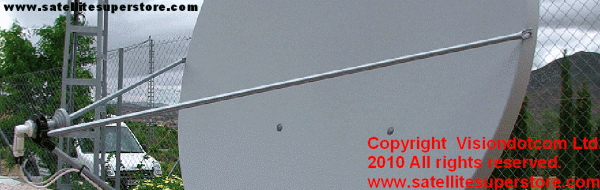
The differences between prime focus and offset dishes.
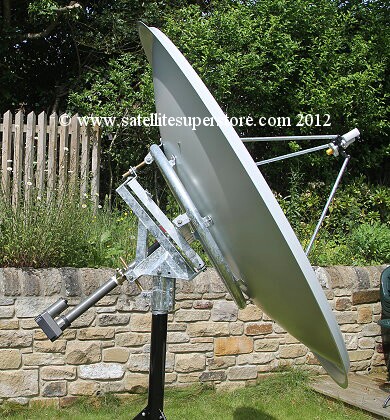
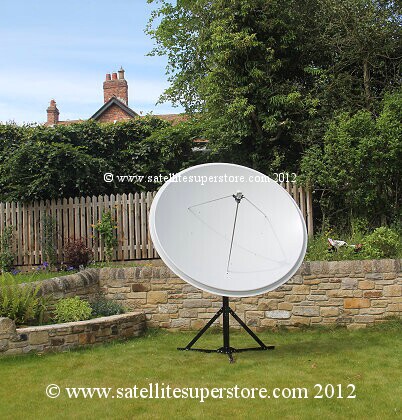
Our new
1.8m Primesat motorised prime focus dish is shown above.
This type of dish is circular NOT oval. It has 3 feed support arms (some use 4 arms) and the 3 arms
converge in the centre. Each arm is 120 degrees apart. The feedhorn uses concentric scalar rings.
The concentric scalar rings reduce noise and improve signal to noise ratio with prime focus dishes.
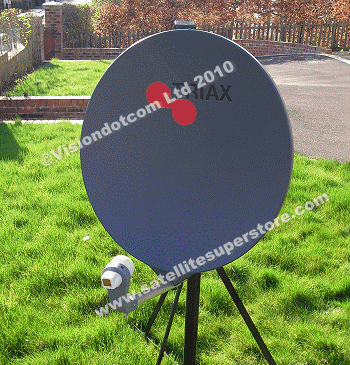
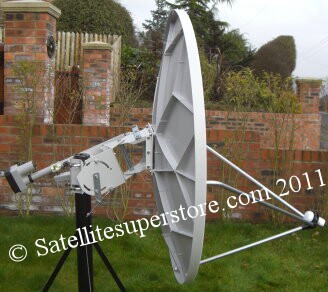
An offset dish (See below) is oval and is higher than it is wide (some are wider than they are high).
They use either one feed support arm (at the bottom of the dish - see bottom left hand picture) or 3
feed support arms (again all in the bottom 1/2 of the dish - see bottom right hand picture).
Many offset dishes use a standard 40mm clamp LNB but some more expensive specialised offset dishes
also use a feedhorn If a feedhorn is used, a c120 flange LNB is bolted to it.
As a general rule the two types of dishes are simply two ways of doing the same job, however, an offset
dish, if well engineered, usually has significantly more gain than the prime focus dish. It is never
really that simple. It is true that petalised offset dishes usually have poor gain but a one-piece
well engineered prime focus dish can be better than a poorly engineered offset dish and some very
good prime focus dishes can have the same gain as a good offset dish of the same size.
As usual you get what you pay for. Cheap prime focus petalised dishes are to be
avoided and we don't sell them.
Prime focus dishes probably look better than offset dishes as they point upwards.
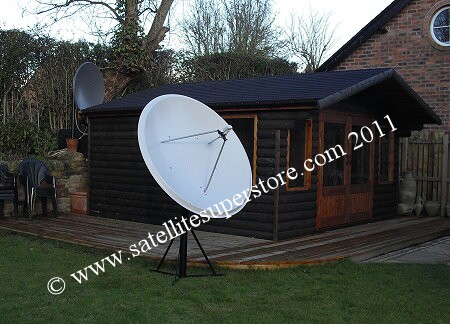
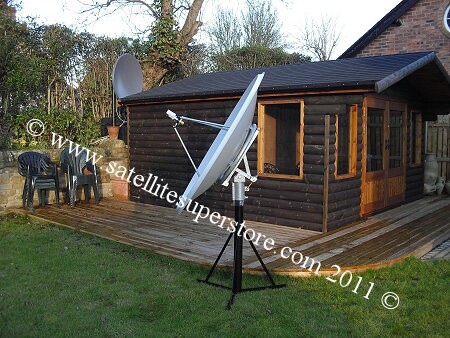
Update Feb. 2011 -
See our new 1.4m prime focus dishes at
fixed 1.4m prime focus dish and
motorised 1.4m prime focus dish
 Update June. 2012 More info. -
Comparing a prime focus dish with an offset dish.
Which has the most gain?
Assuming two dishes have exactly the same area, which is unlikely as dishes of the same quoted diameter are rarely
the same (more about that later) but assuming the same area, and (for the sake of this discussion) the same efficiency
(same accurate parabolic shape, again unlikely) the offset dish should produce more signal as the arms, feed support,
feedhorn and lnb are not in the signal path. However, it is never that simple. A prime focus dish produces a very
precise focal point. (Just like focussing the sun with a magnifying glass), the electromagnetic microwaves can be
focused to a very exact well defined position into the feedhorn.
In addition, any unwanted radiation, (e.g. infra red heat) that approaches the feedhorn from around the edge of the
dish are rejected around the edge of the feedhorn by the scalar rings. These rings produce destructive interference
and therefore maintain a high signal to noise ratio.
The focal point on an offset dish is not as precise and the feedhorn needs to be flaired to collect the radiation.
There are no scalar rings and so it is more likely that noise (eg infra red from around the edges of the dish)
can enter the feedhorn. It is possible that this effect, (improved signs to noise ratio)
can, to a greater or lesser extent make up for the shadows on a prime focus dish due to the feed assembly.
Some manufacturers, when they quote dish diameter, quote maximum, others quote average and some quote useable.
Does the dish work all the way to the edge or is there a roll off area resulting in a much smaller useable area?
Petallised dishes or dishes in several segments tend to have low efficiency as they usually do not form a very good
parabola. once assembled they often lack accuracy.
The quality and rigidity of the feed support arms can also affect the amount of signal being received
Flimsy arms may not hold the feedhorn and lnb in the exact optimum position. It may be possible for the arms to flex
to a position that gives better results but then they spring back again. Paying more for a dish usually provides a
higher build quality. Petalised dishes are usually cheap and have a very disappointing performance. One piece dishes
tend to work really well if manufactured by specialist companies that make quality a priority.
Dishes can be made of steel, (steel needs to have a good coating to stop corrosion) aluminium, or fibre glass / plastic.
The type of material is not really an issue. What can be a problem is if the material is too thin. If it can be damaged
or warped in transit or in high winds.
The backplate needs to be very strong. Here steel is ideal and the best covering is "dipped galvanised". All bolts,
nuts and u clamps should be stainless steel. Brass is a good material for long threaded elevation adjusters.
The gain of a dish should be specified at (at least) 3 frequencies. The feedhorn should be designed for the dish, or
have an adjustable f/d (scalar rings on a threaded adjustment) that can be matched to the dish.
40mm universal lnbs may not be a good match. All prime focus dishes should use a prime focus feedhorn with scalar rings.
A prime focus or offset matched feedhorn should provide an improvement over an LNBF (An LNBF is an LNB with an intergrated
feedhorn, more commonly these days called a 40 mm LNB. Technically only an lnb without an integrated feedhorn
e.g. a c120 LNB or a block type should be called an LNB) if the dish size is 1.2m or larger. (Larger dishes have
a narrower acceptance angle) Whether prime focus or offset, a matched feedhorn should improve the signal to noise ratio.
To summarise, there are good well engineered offset dishes and low cost mass maket offset dishes. There are high quality
prime focus dishes and some poor quality low cost petalised prime focus dishes. As usual "you get what you pay for".
Which look the best?
This is a matter of opinion but the prime focus dish points upwards to the satellite and looks purposeful. When domestic
satellite TV started in the UK in 1985 all dishes were prime focus.
The offset dish reflects the radiation downwards and so the dish face is more vertical (there is an offset angle).
There is a great deal more to this subject than most people realise, hopefully this discussion clarifies some of the
differences. Cost, build quality, the right matereials and good design are the key to maximum
useful signal (High signal to noise ratio.) quality dishes.
QUESTION F9
What is the difference between a Sky mini dish and a standard dish?
ANSWER F9
The differences between a Sky mini
dish and a standard dish (and between LNBs).
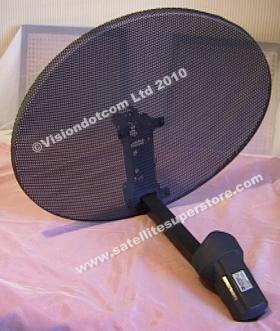
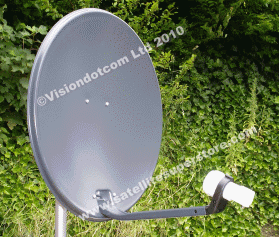
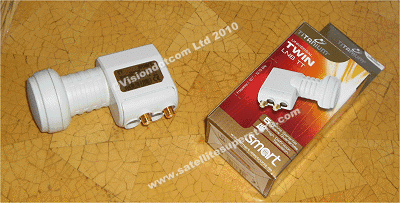
Standard dishes are sold all over the world.
Sky mini dishes are sold in the UK by Sky TV. They are built to the lowest possible price.
All Offset dishes are oval - not circular.
A standard (offset) dish is usually higher than it is wide.
A Sky mini (offset) dish is wider than it is high.
A standard dish uses a 40mm universal LNB. This LNB has a 40mm neck. The dish
uses a saddle clamp to clamp the 40mm neck of the LNB into the 40mm clamp.
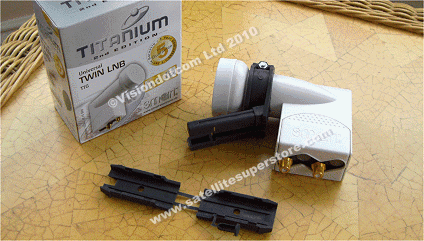
A Sky mini dish uses a Sky mini dish LNB. This LNB has a fitting that either goes into the
rectanglar (cross section) LNB support arm, or fits over it. Either way it fits onto the
arm and not in a saddle clamp. This type of LNB will not fit a standard dish and
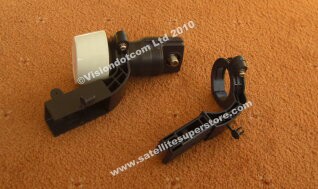
a 40mm LNB will not fit on a Sky mini dish. It is possible to buy a standard LNB and
attach a Sky mini dish adapter (see bottom picture above) so that a standard
LNB will then fit on a Sky mini dish, however, the feedhorn is not an ideal match as the
standard LNB is designed to collect signal from a dish that is higher than it is wide.
This is compensated by the fact that standard LNBs tend to be better (lower noise) than Sky LNBs
There are two reasons why a standard LNB with a Sky mini dish adapter might be used.
1. If the customer intends to upgrade to a (better) standard dish in the future and needs a new LNB now.
2. There are no quatro LNBs made by Sky and so if a quatro LNB is to be used on a Sky mini dish
it must be a standard quatro LNB with a Sky mini dish adapter fitted. (Quatro LNBs are designed
to work with multiswitches) Also note that we do sell a special multiswitch that will work with
a quad LNB and so a Sky mini dish can therefore be used with a multiswitch. This is ideal when
a mini dish is already installed, and has a quad LNB fitted to it and is very inaccessible
so difficult to change. Since multiswitches are professional products, it is, however, best
to fit a higher quality standard dish with 40mm quatro LNB if possible.
Sky quad LNBs can be fitted to a standard dish. If the Sky adapter collar is removed, then
a small piece of plastic that stops the collar from rotating is cut off with a craft knife,
this will leave a 40mm neck and the LNB will then fit a standard dish.
MOTORISED DISH QUESTIONS
QUESTION M1
What do you think of Diseqc Motors?
ANSWER M1
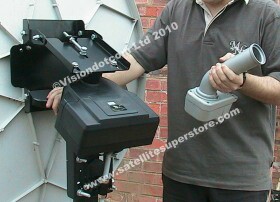
This is where digital receivers now contain software to control a Diseqc motor (right hand side in photo) rather
than a hardware positioner board to control a standard 36V motor (left hand side in photo) motor.
There are, therefore two types of motors. Diseqc motors and 36 volt motors.
36 volt motors are designed for larger dishes. They inject more power down a separate cable.
We would recommend a Diseqc motor on dishes up to 90cm steel or 1.0m Aluminium as long as the
1.0m dish was not in a very exposed location. A Sheltered location would probably have a wall behind it
An exposed location would be a high pole above the gutter.
There are Diseqc motors with nylon gears and Diseqc motors with metal gears.
There is nothing wrong with nylon gears. Some big 36 volt motors on 2,4m dishes use nylon gears.
They are very quiet and strong. We have sold the Technomate 2100/2200/2300 with nylon gears
for many years with virtually no problems at all. Never see them again. Very reliable.
Some Diseqc motors use metal gears. Since a Diseqc motor cannot be made any larger as only the LNB
current is available to drive it, it can be made a little stronger with metal gears but they are a little noisier.
For that reason we would recommend Diseqc motors for 1.0m and 1.1m dishes.
For 1.2m and larger dishes, 36 volt motors should be used.
The Technomate TM-2300 and TM 2600 motors
The 2300 uses nylon gears and the 2600 uses metal gears.
Compared to other Diseqc motors, there is no noticeable play in the gearing in Technomate motors.
They also tend to be a little faster. They hang from above (like an elephant trunk) which makes
installation easier.
The problems with Diseqc motors and why the V box is so necessary with larger
dishes.
Diseqc is a development where digital receivers now contain software to control a Diseqc motor rather
than a five amp hardware positioner board to control a standard motor. The motor control works digitally
down the coax signal lead and a 4-wire control system is not required. Also the concept has become an
industry standard. Sounds good so far but what are the drawbacks?
1. The coaxial cable is designed to carry the signal from the LNB to the
satellite receiver. It is also designed to provide power to the LNB. The satellite receiver provides about
500 to 600 mA (0.6A) to power the LNB. Typically an LNB might draw about 300 mA. This leaves 200 to 300mA
(0.3A) to power up a Diseqc motor. Clearly a proper hardware (4 wire control system) positioner which
can provide up to (typically) 3 to 5 amps can drive better bigger, stronger, quicker motors.
With 300mA a Diseqc motor must be smaller. The only way a very smaller motor can move
a dish is by putting a large gearbox on the end of the motor to provide "leverage". This means that
a Diseqc motor moves more slowly from one satellite to another due to the large amount of gearing.
Diseqc motors should only be used on dish sizes that are within the ratings outlined above.
Our opinion of a recent conversation,
I was talking to another dealer the other day. He said he fits a Diseqc motor to the Andrews (Channel
Master) 1.2m dish face. The Channel Master is a heavy dish and the wind loads on a 1.2 can be massive.
In addition, this Channel Master dish is available with a wonderful heavy duty Channel Master
polar mount and actuator (or the big 15 Kg 1224 Supermount H to H motor.)
and yet this dealer fits a Diseqc motor to this large 1.2m dish face! (It is like ordering a
6.5 litre Rolls Royce from a dealer and saying "will you please fit a 1 litre engine before supplying it."
Unfortunately many dealers (and some magazines) are prepared to go down this route. What we need
is a bit of common sense. Why is wind load never considered? Every year we see numerous insurance claims.
Our recommendations.
For motorised use, The Diseqc motor works fine on steel dishes up to 90cm and aluminium dishes up to 1.0m
in "normal" locations. For larger dishes, or exposed locations (e.g. above the gutter on a high pole
or on the west coastline of Scotland or Ireland,) or for larger dishes use a V Box and a 36v motor.
Information from Jan 04
We have tested a new "Cryptic" Diseqc motor last weekend.
The reason for testing it was that for the first time a motor became available
that bolted onto the back of a 1.0m aluminum dish. Being a Diseqc motor
it was expected that it would still be slow (and it is) but this looked
very promising as the big problem of “universal fit – fits nothing properly
and slips in the wind had been overcome. We really wanted this solution
to work for us. It was set up with a Digiquest 8000 and using the USALS
facility all satellites were programmed in. Looked great.
However !
Taking hold of the edge of the dish, (at a distance of about 0.5m from the centre
Of rotation) there was play (movement) of about 7 mm. This was found to be in
The actual motor shaft between the rotating output shaft and the motor body
(i.e. in the gearbox) Looking at the shaft the movement was about 0.5 of a degree.
Now - last Saturday there were moderately winds (not gale force) and the dish
Moved on and off the satellite (no signal) every few seconds. Not a “peaky”
Low power satellite! We were on the Hotbird.
We contacted the supplier and were told that there is a certain amount of play
In all Diseqc motors as they use a worm drive to gear them down.
(small low current motor – large gearbox)
The only time you might get play in a 36 volt motor is when it has been used every
day for many years.
A typical e-mail. (Dated May 03)
Dear David,
Did not believe in UFOs until recently, when looking through my window I saw a UFO descend
vertically and crash. I soon found it was my 1.2 metre Channel Master dish, still firmly attached to top of
Jaeger mount, having left behind rest of mount, still on top of pole. If you will examine the
top plate of a 128, you will find it is held on by 4 small countersunk screws. In my case,
wind on dish had managed to tear the heads off inadequate sized screws. If you check 128
you will my point, that screws are too small.
Reply,
The 128 is a 36 volt motor but it is still too small a motor for the Channel Master 1.2m
as it only weighs 4 KG The correct motor (2 types) - both weigh 12 KG each
So nothing you say here is a surprise to us as we tell people that every day of the
week and follow other dealers insurance claims round. You should use the Channel
Master polar mount and 12 inch actuator or the 1224 motor with plate.
Update July 06
The Technomate TM-2200
We have tested the latest Technomate Diseqc motor and it is better than any previously tested
It works well with 90cm steel or 1.0m aluminium dishes and it does move faster than
other Diseqc motors. There is no noticeable play in the gearing.
We are therefore pleased to include it in our product range. Only dishes
on our site that fall within the size recommendations just noted are
available from us with this motor. For larger dishes or exposed
locations use a 36V motor.
Update Aug 09
The Technomate 2200 Diseqc motor has been further improved and is now the
2300.
Also see the new
Technomate 2600 motor.
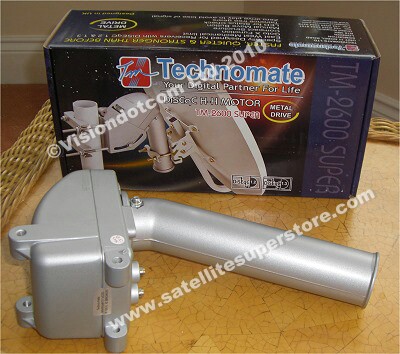
Shown above is the new Technomate 2600 motor which uses metal gears.
This will make it produce slightly more noisy than the 2300 but will allow it to be used with bigger dishes.
The 2300 motor is an extremely reliable product with virtually zero returns or problems.
Using steel dishes up to 90cm and aluminium dishes up to 1.0m (as we advise) it is an excellent choice.
For 1.0m and 1.1m steel dishes this new 2600 motor would be a better choice. We do not recommended the
use of Diseqc motors (metal gears or otherwise) with 1.2m dishes or larger. Here larger 36 volt motors
should be used. It is interesting to note that the 36V 15Kg 1224 Jaeger motor that has been used on 1.2m
and 1.5m dishes for the past 15 years (with total reliability) uses nylon gears! There is more to this
subject than the material used to make the gears. A good way of assessing the capabilities of any motor
is the overall size and weight of a motor and here the 36 volt motor is the best option on larger dishes
no matter what claims a manufacturer might make!
QUESTION M2
What is a polar mount?
ANSWER M2
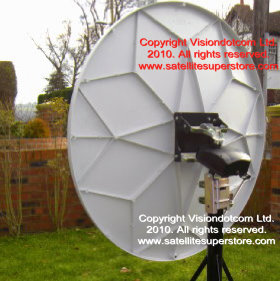
This is the part that turns with bearings top and bottom like track rod ends on a car's
steering. An actuator (motor) pushes the polar mount round. Dishes experience high wind
loads and even in normal use are moving back and forwards several times a day. The quality
of the polar mount and motor is extremely important. The design of a horizon to horizon
motor makes them inherently less able to withstand wind loads so it is important
for them to be even bigger / heavier duty than a polar mount for a given dish size.
Providing they are bigger, they are very good. Although most H to H motors go further
east & west than polar mounts, most satellites are within 30 degrees east to 30 degrees
west. Most polar mounts will easily cover this distance. It should by now be obvious
that one (e.g.) system can be very different from another when comparing prices.
You may not find out how poor a polar mount and motor (or H to H motor) is until you
have purchased it. Remember you need to ask the right questions. Its like buying a
car. You might ask the price of a Vauxhall Omega. There is a big difference between
a base model and the Omega Elite. About £15000 worth of difference! Some customers
however are not even as knowledgeable as this. They say "How much is a motorised system?
Its like saying how much is a car? Which car? Specify every item before comparing prices.
Become knowledgeable before you part with your money. Quality motorised systems
start at about £300. You cannot compromise where gale force winds are concerned.
Heavy duty polar mounts and actuators tend to be used on dishes of 1.2m or larger.
QUESTION M3
What is the difference between a
polar mount and an H to H motor.
ANSWER M3
Two ways of doing the same job but ....
Polar mounts are a little less expensive and cheaper to fix in the future.
To fix an H to H usually you have to replace the whole motor. You loose all
is the dish settings. An 12 inch 36V actuator costs £39 and can be changed
without removing the polar mount. Dish settings don't change.
Good polar mounts (including the Andrews) are inherently stronger than H to H motors of
the same size as the actuator pushes some distance out from the centre. The actuator is
also therefore better able to resist high winds than gears in the middle.
(lever law) although with a good (strong) H to H like a 1224 there is not much
difference. Also when you look at the massive 1224 Supermount H to H motor, it is so
heavy duty and over-rated it is stronger than many medium duty polar mounts!
H to H motors go further than polar mounts, + or - 70 degrees. Polar mounts should go
from 45 east to 45 west. (The length of the actuator is misunderstood relating to travel.
If the polar mount was pushed at, say, 75mm from the rotating centre, the dish would
travel further than if it was pushed at 150mm from centre, each for the same
actuator travel. Hence it's the total design of the polar mount that determines travel,
not just the stroke of the actuator. Many people put too large an actuator on their
dish when a smaller one will actually go so far that the dish would foul itself
before the actuator was fully extended.)
(See also question M7 below - more details in the answer.)
Dave.
QUESTION M4
Some companies include a free wall mount with a
motorised system. Why don't you?
ANSWER M4
This is a Safety Issue. If you were buying a car and a manufacturer offered a few pounds off
because it had a free braking system would you buy it? So - the cheapest possible parts were
used and there was a chance it would fail and cause an accident. BUT IT IS FREE!
It is very difficult to make customers understand that with some things in life,
PRICE IS NOT AN ISSUE, ONLY QUALITY IS. That is why for over 18 years we have designed
and manufactured our own fully welded heavy duty wall mounts and ground stands.
That is why, whilst we have been out to many insurance claims over the years
and they have always been caused by other peoples wall mounts breaking.
Like the dish that fell on top of the car in the drive in high winds. They were lucky!
It did not fall on a person. We have yet to see a decent commercially made wall mount,
We have seen wall mounts bolted into only two bricks and the whole kit on the ground
still with the two bricks still attached! The bricks were pulled out of the wall by the wind.
Some wall mounts are compromised by being flat pack able. Ours are heavy duty and held onto
the wall by 3 times as many bolts as most. Being fully welded they are bigger to ship,
but that is not important. Most wall mounts dealers use are T and K brackets.
(Because they do not have their own manufacturing resources and that is all they can get.)
These are designed for Aerials not satellite dishes. Dishes are a much bigger sail in the
wind. If you see a free wall mount, or one using 3 bolts to hold it up (ours use 10+)
or thin narrow metal then beware. We keep samples to show callers. All of the samples
have sheared in the wind and have been collected from insurance claims. It's up to you.
Our mounts are on our
the wall mounts and ground stands page.
We do not know whether in your situation you need a south facing mount, a mount with
a 2m pole to get the dish above the gutter,
or a ground stand. Therefore we have a
page dedicated to this requirement. All of the mounts are big heavy duty units.
QUESTION M5
Can I put Sky Digital or freesat all on the one motorised dish
as my CI motorised receiver?
ANSWER M5
Yes you can, using a twin output LNB and a second cable. BUT, is more flexible to have
2 dishes as then one channel from say Sky can be watched in one room and a different
channel in another. Or record one channel (copyright permitting) and watch another.
Also all of your eggs are then not in one basket. A fault on one system and the other
still works. Since the Sky mini dish is very small it is not easy to notice.
All on the one dish requires a twin LNB and again 2 cables. Each cable goes to each
receiver. There are many ways to connect the two receivers to the TV. One way is to
connect the Digigox to AV 1 with a scart lead. Then connect the motorised to AV2
on a second scart lead.
QUESTION M6
You seem to recommend the Technomate 6900 and Lyngbox
receiver for motorised use. What makes them so good compared
to other receivers on the market?
ANSWER M6
Many receivers simply do not have enough memory locations for all of the channels.
With a 1.0m motorised dish we can scan in over 9000 channels.
A 10,000 channel capability (minimum) is recommended. These receiver have this.
They also have advanced scanning capabilities, are easy to use and have many useful features.
See
Technomate 6900 and See
Lyngbox
QUESTION M7
Which satellites can be seen from the UK?
ANSWER M7
(See also question M3 above - more details in the answer.)
Satellites are in the "Clark" belt in geostationary orbit above the equator.
From the UK we see this as an arc in the southern sky.
The centre of this arc is approximately zero degrees. (It is exactly zero degrees
if you are on the Greenwich meridian which is a longitudinal line through the
Greenwich observatory in London.) Realistically we can see about 70 degrees east
of due south and 70 degrees west of due south before our horizon gets in the way.
So really the maximum arc we can see in the southern sky is about 140 degrees with
due south in the middle. With a motorised dish and a good motor 60 or 70 east to
60 or 70 west is possible providing a clear line of site is available.
The signal comes in at about 22 to 24 degrees to the horizontal in the centre
of the arc, but at the apex of the arc at say 70E or 70W it could be around
5 degrees to the horizontal so trees buildings and hedges even in
the distance could be in the way. Here in Europe we talk about satellites at 10E of
south or 30W of south but in the US for example, they will start to see satellites in
the mid Atlantic which will be about 70west and as you cross America to the west coast,
then into the Pacific, you would finally see up to 150 west from the west coast of America.
It follows that any satellites from 70 west onwards are below our western horizon.
A polar mount and actuator can usually span about 45 east to 45 west. With this type
of motor you can, if you wish, "pinch" a bit from one side to give to the other.
e.g 55 west to 35 east. The 1224 EL motor will go from 70E to about 30W as the inclined
orbit jack will restrict movement to the west. Most channels of interest are within 30E
to 30W anyway so all motors are fine and there are other factors to do with strength and
wind load that are more important to a motors design than whether it will go to
the extremes of the arc where there is little of interest anyway.
(See also question M3 above - more details in the answer.)

Linear 36V Actuator Information.
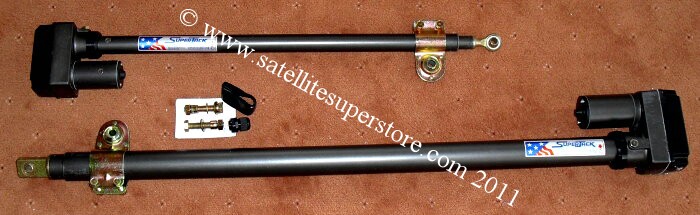
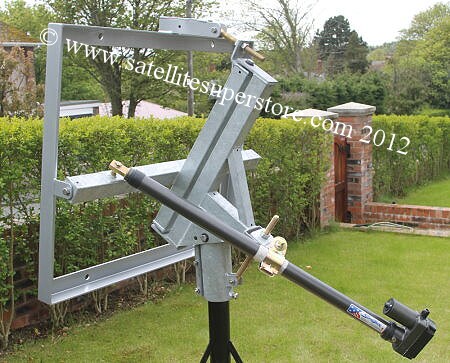
Straight (linear) actuators fit many types of
polar mount but you need to know the length of actuator you require.
Straight actuators push a polar mount east and west and the polar mount follows the satellite arc. They are available in various lengths.
The Raven (formally Andrews or Channel Master) polar mounts for 90cm, 1.0m and 1.2m use a
12-inch standard actuator or you
can use an
18-inch standard actuator on the
1.2m Raven dish. The polar mount for the Raven 1.8m. dish uses an 18-inch heavy
duty actuator. The Primesat 1.8m dish uses a
18-inch heavy duty actuator. The Raven 2.4m dish uses a 36-inch actuator. The
The 3.7m dish uses a
36-inch actuator. Referring to the top left hand picture, the top actuator is a standard actuator
and the bottom one a heavy duty actuator. A heavy duty
24-inch actuator weighs 7.0 Kg. A standard
24-inch actuator weighs 4.5Kg.
Heavy duty actuators are thicker and heavier and due to a larger motor, have more torque. The spare part which does the counting is
called a
Reed Switch and is available below. We also sell
inclined orbit polar mounts. These mounts are for tracking inclined orbit
satellites which move in and out of the "Clarke Belt". They use 2 actuators. One for east and west and the other for up and down.
Polar mounts are used for dishes of 1.2m and larger. The inclined orbit polar mount with 2 actuators for the 2.3m dish weights 64Kg!
These polar mounts are manufactured within our group of companies.
"Superjack" actuators.
If it says "Superjack" on the side of the actuator it is a genuine Superjack actuator.
Beware - some web sites may show pictures of "Superjack" actuators and may state in the notes that they are "Superjack"
actuators but when you receive the actuator it may be a different make (often a similar sounding name but
not "Superjack"). It may be cheaper but please note that an original "Superjack" has a high build quality.
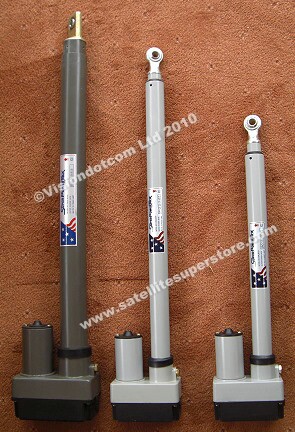
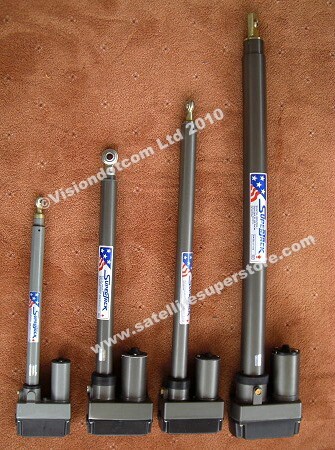
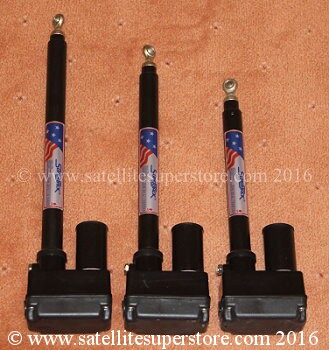 Genuine Superjack actuators are available below. All actuators include -
A
Free test cable and our own specially prepared "
testing and fitting guide" is
included with every actuator. (Worth £9.50)
We have sold 36V actuators since 1991 and our proven methods are worth following. We recommend a test procedure before
fitting a new actuator as detailed in our notes. We have a dedicated technical help line, just for our customers. We can guide
you through the testing and fitting process. You can buy a discounted spare
Reed Switch for only £1.95
(saving £3.00)
if included
with any new actuator purchased. You can even include a new Primesat high-tech
V
Box for only an
extra £29.95 (saving £10.00)
with any new actuator purchased. ("
Motor control
cable" is also available).
Feedback e-mails.
Subject: My New Echostar System (30th Aug 03)
Hi Dave,
I am writing to tell you how delighted I am with my new system and with
the help and guidance I have received from yourselves ( a special
award to Noel for his patience when I was being especially dense) from start to finish.
Your website is clearly laid out and informative which allowed me to
make sensible decisions about equipment, and your video and personal advice
convinced me that I actually could undertake a task which initially
seemed daunting and about which I still harbored doubts a good way into the project
In truth the only really difficult part was that I had to put the whole thing up on the wall of
my house on my own which added greatly to the time involved -
I'm also not very keen on working at gutter level!
Having done it I would reiterate to anyone else embarking on a similar
enterprise GET THE MAST PLUMB in flaming letters ten feet high!
I know you emphasize this already but it really does make what I thought would be the
most difficult part which is aligning the dish and tracking the whole arc so easy.
The Echostar unit really is excellent and worth the price in my opinion and
again I see your points about "proper" navigation and built-in positioners.
Into all of our lives a little rain must fall however, and as I mentioned to Noel
at the outset a couple of things were missing from the box. The packaging wasn't damaged
and I assume they were just overlooked.
I have gone back to the original order and these are the two scart to phono leads Item# STPLEAD.
If you could let me have them sometime I would be grateful.
Regards
Martyn
PS. If you would like to quote any of this I am more than happy for you to do so,
it is so rare to find a uk based Co which knows the meaning of service.
Dear Martyn,
Thank you for the feedback
No problem
We were waiting for the leads to come in but we have them now.
Leads going tonight
Dave
Update Sept 09. Echostar discontinued use a
Technomate 6900 and See
Lyngbox.
A a
V Box if a 36v motor is being used.
Dear Dave,
Thanks once again for your assistance - I didn't mention the programming option
but once everything is tracked in this in itself is worth every penny,
at this stage all the amateur such as myself wants is to play, not
spend hours sorting out channel info.
The most amusing part of the entire process was that I had to get two
connectors from my local tv
and satellite shop to connect the Digisat meter.
When I told them that I was installing my own motorised system they were
highly amused to say the least, but within 1 hour the job was done. The look
on their faces was worth the effort involved!
Martyn.
e-mail dated 09.01.01
"As a newcomer to satellite TV, I have found your site very helpful,
and with the aid of a satellite finder kit supplied by yourself, I
saved time and money by realigning my dish without the necessity
for waiting in all day for an engineer who may or may not turn up."
(
Our Comment. It's rewarding to receive feedback like this.
It makes all the time spent building the site with advice and including
the right kind of products very worthwhile. Satellite finder
kits can be found on our
Satellite Meters Page.)
e-mail dated 15.08.01
David, last year I purchased Triax 1.1 metre dish, your ground mount, and good cabling and satfinder
kit+video, and this is running on a gemmi gold motor feeding a Strong 4375 decoder.
Having read everything on the subject and watching your excellent video I finally got round to installing
the system this week between showers here in Northern Ireland. The dish is mounted in the back garden on 4
concrete paving slabs and well bolted down and plumb(very easy to get plumb with the adjustment bolts
on the ground mount).
Well to say the least the install was very easy after this and is tracking the
arc nicely. I can get about 35 degrees east/west from thor and this is more than I expected. I am more
than happy with the equipment supplied and i just want to thank you for making this
job so easy as you
seem to be the only one on the subject who takes the time to reply to questions.
p.s. your mail order was very fast with the dish and ground mount being so heavy and delivered to my
door in N.Ireland.
Thanks again David for the good service.
3/4 satellites on 1 fixed dish. Advice and feedback.
see
3/4 LNB systems and brackets
Advice - Using a Sky box as well.
If you look at the twin LNB option above at you will see this issue is dealt with.
i.e. Using a twin LNB in the 28E position, you could have the twin and 2 single
LNBs on 28E, 19E and 13E
Using the FTA / CI receiver on one output of the twin and the 2 single LNBs
all three satellites will then work on this receiver.
The second output of the twin could go to the Sky Digibox
Alternatively, without the twin option, the FTA / CI receiver could connect to 2 satellites,
19E and 13E. Then the Digibox to the 28E LNB
Either way, two cables must be brought into the house for the 2 receivers.
Advice - Using all four LNBs,
The Triax multisat dish kit can be used on any part of the Sky but in the UK the
common satellites to point it at are 28E, 19E and 13E (or 28E, 19E and 16E or 28E, 16E and 13E
but for these two options a 90cm dish is needed as 16E is a lower power satellite than the other
three satellites) We used to say you cannot get 28E, 19E, 16E and 13E as, even with narrow feed LNBs
you cannot get 3 satellites that are only 3 degrees apart. The narrow feed LNBs can
(unlike standard LNBs) get close enough together to get 19E and 16E or 16E and 13E - here
the LNBs must touch each other to do this. But to get 19E, 16E and 13E, with all three LNBs
touching each other, they are not close enough together. To put it another way, if you set up
one LNB on 19E and another LNB on 13E, a third LNB on 16E will not fit between the other two LNBs.
Therefore, used in this part of the sky for these satellites we used to say that three LNBs would be
used on 28, 19E and 13E and the fourth LNB would be a spare (it is part of the kit). Recently our engineer
did a little experiment. We should point out, however that this would invalidate the warrantee on three
of the LNBs! With a craft knife he shaved some plastic off the sides of the narrow feed LNBs to make
them narrower. The plastic is quite thick and so this is possible without going right through the casing.
He was then able to get 28E, 19E, 16E and 13E perfectly on a 90cm Triax dish.
Up to you!
Advice - using the Triax Multibracket in France.
(This is NOT an issue in the UK where the bracket works fine on an 80cm dish. - although in the
north a 90 is recommended)
To get Sky / 28E in France you need a 60cm in the North, 80cm by the time you get to Paris
and a 90cm in the south and south west.
(We quote dish sizes to receive the lowest power channels like the BBC although smaller dishes
will work on a % of the channels but not the lowest power.)
Astra and Hotbird are powerful in France and probably only need a 60 for either.
So using a 90cm dish and multibracket in the south is then a problem as you are sharing
the signal between 3 satellites and there is therefore a drop in signal of maybe 3 to 6 dBs
on LNBs not in the centre of the boom arm. (centred on 19E, the 28E LNB is off-centre)
It therefore follows that a bigger dish is needed to make up for losses in a lower signal areas like France etc.
A solution, in theory, might be the Triax 1.1m dish which is also compatible with the multibracket
but we have had no sales of that type and hence no feedback from customers to confirm it works well in that area.
Also note that on the mutibracket page there is a twin option so that a twin LNB can be put in the 28E position
on the bracket so that a Sky Digital can be used as well as a CI receiver.
Advice - using the Triax Multibracket in Spain.
CUSTOMER FEEDBACK Feb 07.
Good morning,
Having spent a lot of time visiting your site, I would like to pass on some information to you regarding an
installation that I have finally sorted out.
I live on the Costa Brava in the town of Roses; and for some time wanted to view Astra 1 and 2
using the same dish- despite attempting a motorised system and two separate dishes, I was never
able to see both the Spanish Digital + system on Astra 1 and the FTA channels on Astra 2 well enough.
So I purchased a Triax 110cm dish, a multi lnb bracket, and a VisionNet FCIS 7000 reciever. I now have
over 300 FTA channels on Astra 2, all the Spanish system, and the added bonus of all the new Spanish
freeview system. It has a taken a little bit of patience, but as now I have 95% signal quality on
the FTA channels on Astra 2 ( in fact, better than Astra 1 at about 75-80%), I am more than happy.
I know that you have requested any feedback regarding Triax and their multi-lnb bracket; well, please
advise all those who are thinking about purchasing or installing, that here in northeast Spain, the
results are spectacular.
Thank you for your time, keep up the good work.
Regards,
Patrick
Feedback from Ireland
Feedback. I got a 90cm Triax Dish, Diseqc switch and multi-arm bracket from you last year
and it is working a dream in Dublin - I use 3 of the LNBs for Hotbird, Astra 1 and Astra
2/Eurobird.
By the way, when setting up the multi-arm I found that the maximum 'tilt' of the arm was
quite limited and was insufficient to get a good signal from the 3 satellites.
Must be the vertical angles in Dublin! I had to do a bit of cutting/scraping to
increase the tilt but it works great now (~80-90 signal from Astra 1 & Hotbird
and over 90% with Astra 2). Regards, Dominic
Advice - using the Triax Multibracket with other dishes.
Over the last 10 years we have tried a number of universal 20 degree kits and none of them worked
properly - producing very low signal on all satellites - often flexible plastic and poorly made.
In 2005 Triax introduced the multibracket kit for the range of TD dishes.
We were skeptical but we tested it and it worked well.
Please note the following,
The Triax Mulibracket.
It is a precision engineered aluminum extrusion design.
It fits the Triax Boom arm and not other arms.
The design program was to match the arm to the dish so that they work properly together.
1000s sold and customers know they work
It may work properly on other dishes and will not fit anyway.
That is not to say that if you put your mind to a modification to make
if fit other dishes that this could not be done. Anything can be achieved
with a little work and skill but we certainly cannot comment on whether
a DIY mod will provide good results.
BUT
After 6 months of work and testing we have adapted it to our clear transparent 85cm
dish and it works very well. This modified unit is now available and good feedback
has come in from users. See
2, 3 or 4 satellites on 1 fixed dish
Problems of using more than one diseqc switch
with multiple LNBs
One our web site you will find 2, 3 and 4 LNBs on one fixed dish
See
2, 3 or 4 satellites on 1 fixed dish
You will also find options for the fitting of a twin or quad LNB as a substitution
with ONE of the 3 or 4 LNBs so that a popular satellite can go to several receivers.
e.g. putting a twin or quad in the 28E position so that a Sky digibox or Sky + can
be connected as well as the CI receiver to that LNB That means the CI receiver and the
Sky box both are connected to 28E but the CI receiver is also connected to other
satellites through ONE diseqc switch.
You will not find on our site 2.3 or 4 satellite kits with twin or quad LNBs and
more than one diseqc switch to either two receivers or a twin tuner receiver.
REASON.
Whilst it should all work in theory, in practice
(depending on the combination of switch positions) you can get no signal on a
satellite when it should all work. This is because twin LNBs and Quad LNB should
be fully connected to work properly. It may be OK to connect to two outputs of a quad
but you have to experiment to find out which two. With a twin, one side has a good
connection to the internal power supply circuit and the other is almost like a passive
device and relies on power from the second receiver to work properly
If you connect two or more diseqc switches, they take power away from some of the
outputs of the twin or quad LNBs (depending on the switching at the time) and
things go wrong.
IS THERE A SOLUTION?
Yes there is - a new solution - but quite expensive. It will be on our site soon as
an option on all of the twin tuner receiver pages eventually but see it at
multiswitches
The 9 in and 6 out and the 17 in an 6 out ...etc. This is a product designed to
do the job. Quatro LNBs must be used but all the switching is done inside the unit
and there are no power issues
Update April 2010. The twin lnb options with Discqc switches
all designed to work together do work without problems if
part of the "Inverto Multiconnect" 3 and 4 sat systems.
If you e-mail us,
We receive well over 100 e-mails per day and we do try to answer them.
It is very important to use the contact forms on our web site on the
Contact Us page.
These come straight through with no problems and are given priority. Using our e-mail address can result
in us not receiving the e-mail since we do have a strong spam filter in place and sometimes genuine
e-mails may be blocked.
On a busy day it may be that the answer will be in the following morning as often we catch up with mails from
7.30 till 9.00am before the phone lines start. If the phone is ringing every few minutes during the day,
answering e-mails may be delayed till the next morning.
There are some mails we will respond to with a "set answers",
If the mail is covered by an FAQ, you will directed to the FAQs on these advice pages.
If you require email support on a product you have purchased from us, this is done through the
after sales support form on the contact us page. You will need your invoice number.
If you have bought a product elsewhere, you should contact that company for support
and not us. We look after our customers, not customers from other companies.
There are some e-mails we will not answer.
E-mails that are not in English are immediately deleted.
Answering 100s of e-mails takes time and working out what "text language" all means is something
we do not have time to do. We only answer questions in English. Text language
e-mails will be deleted.
We are a SATELLITE company. Questions about aerials, or cable (e.g. NTL) will not be answered.
We do not sell products for cable users. Contact your cable provider.
We do not provide advice on “internet via satellite.”
We do not provide advice on satellite computer cards.
We do not provide advice on "card programming" or card programmers.
(Questions from the USA) We do not provide advice on systems to unscramble US channels.
If you would like advice about receiving a particular channel, you must state which
satellite it is on (there are over 8000 channels in the sky) and include where you live (which country)
if we are to advise on dish sizes etc.
If you are asking several questions and e-mails are going back and forwards
between you and us, you must include all of the e-mail history below from the previous e-mails.
You cannot expect us to remember your exact circumstances from one mail
to another. We rely on the history to be able to remember your circumstances.
Customers using aol tend not to include the previous e-mail history. Please do so.
Many companies simply do not answer their e-mails. We try to answer all of ours with the exception
of the categories above. If you send a mail and it is not answered
it may have been accidentally deleted. This can happen as we receive (as I am sure you do)
large amounts of junk mail every day and it is possible that a genuine mail may be accidentally
deleted among the junk mail. If you think that has happened please send it again.
Through the contact forms there should be no problems
We do try to answer all genuine e-mails.
See our other web site at-
www.primesat.eu
This site includes many products that are exclusive to the Satellite Superstore.
The site contains -
• Products that we manufacture (e.g. We have manufactured heavy duty wall mounts and ground stands since 1991).
• Selected products which have our own Primesat brand name and have been prepared to our specifications.
• Selected products where we have been appointed the authorised UK or European distributor by the manufacturer.
www.primesat.eu is an information site. Here you will find full specifications and many detailed pictures.
To buy any of these products, simply order them on this web site.
Link to our own satellite museum site
Satellite Museum. A museum of vintage satellite receivers.
See www.satellitemuseum.com
 For old satellite receivers with knobs on and read about "A History Of Satellite TV".
Also see
www.rewindmuseum.com. A Museum of vintage consumer electronics.
Vintage reel to reel video recorders. Vintage VHS and Betamax VCRs. Vintage video cameras. Vintage
Laser Disc. Vintage Computers. Old telephones. Old brick mobile phones. Vintage Hi Fi, Old reel
to reel audio and early audio cassette decks. Including, the history time line of vintage
consumer electronics ... and much more .....
 It is well worth a visit.
Only The Satellite Superstore brings you
great products, advice and it's own museum.

You may be interested in two other web sites.
 www.1952chevytruck.com
This web site shows all of the restoration process and the modifications to this truck.
www.1952chevytruck.com
This web site shows all of the restoration process and the modifications to this truck.
In addition, there is a hard high quality tonneau cover on a new web site
at www.classictonneaucover.com for the 1947-53 Chevy truck.

Contacting us.
Unlike many other companies we are happy to answer questions on the phone.
Tel. (UK) 01207 544664 and 01207
544224
International Tel. + 44 1207 544664.
Before sending questions via e-mail please check-out our
Frequently Asked Questions as
this could save
time.
If you have any questions & comments regarding this site's content, or you need advice please ....
click here to go to our contact forms.
Copyright © 2019 Vision International. All rights reserved.